The Jevons paradox of decisions
In 1865 Jevons saw better engines make Britain burn more coal, not less. Cheap AI decisions follow the same pattern, with a twist that lands on the people who review them.

The 60-second version Open
- When something gets cheaper to use, total use can rise instead of fall. Whether it does depends on how hungry people are for more.
- Inside the jobs a company already does, cheaper decisions multiply the count and shrink the bill: in the book's model, about 8 times the decisions for a quarter of the spend.
- The bill rises through new jobs that were never worth doing before.
- Every extra decision can become work for a person. A rule set as a share of volume grew from 136 cases a day to 1,185; a cost line stayed at 175.
- When decisions get cheap, set thresholds by cost, not by share.
In 1865 a 29-year-old economist named William Stanley Jevons published a book about coal, and it made him famous almost overnight.
Britain ran on coal. Its factories, mines, ships and railways all burned it, and people had started to worry about how long it would last. The comforting answer was engineering. James Watt's steam engine got far more work out of each ton than the engines before it, and engineers kept improving it. Surely, as engines got more efficient, Britain would need less coal.
Jevons said no. More efficient engines had made coal-powered work cheaper, and cheaper work got used for more things. Engines that had been too costly to run became worth running, in more mills and more mines. Each engine used less coal. Britain used far more.
"It is wholly a confusion of ideas to suppose that the economical use of fuel is equivalent to a diminished consumption. The very contrary is the truth."
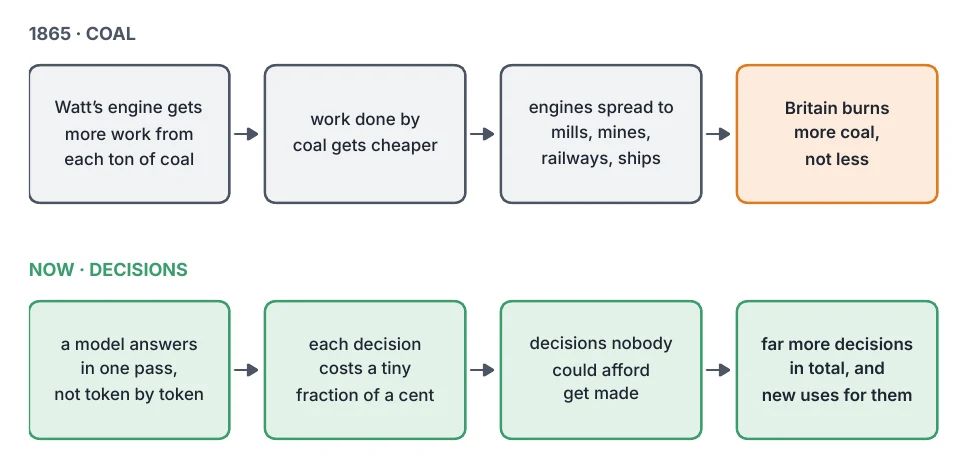
Cheaper things get used for more things
You already know this pattern. When a photo meant film, developing and a trip to the chemist, you took a few dozen on a holiday and chose each one with care. Then each photo became essentially free. Nobody takes the same few dozen photos for less money. You take thousands, of receipts and parking spots and whiteboards, because each one is now worth taking.
That's the Jevons paradox: something becomes more efficient to use, each unit gets cheaper, and total use rises instead of falling.
It isn't a law. Plenty of things got cheaper without anyone using much more of them. Salt is cheap, and you don't eat ten times as much as your great-grandparents did. What decides it is how hungry people are for more: economists call it elasticity. If demand barely grows, a price cut mostly saves money. If demand grows faster than the price falls, the total bill goes up.
So the question for decisions isn't "is the paradox true?" It's how many decisions aren't being made today, only because they cost too much.
The decisions nobody makes
Every decision has a value: the expected loss it avoids. Checking an alert that has a 3% chance of being a $10,000 breach, when a good decision would stop it, is worth about $300. A decision is worth making when its value is above its price.
Kestrel's security team makes a few thousand careful decisions a day. But the company generates millions of possible ones: every email, every login, every line in the logs. Each is almost certainly fine. Each is worth checking for a sliver of a cent.
| Decision pool | Per day | Typical value of one decision |
|---|---|---|
| Alert triage | 714 | $6 |
| Agent steps | 3,700 | $0.50 |
| Checking LLM outputs | 20,000 | $0.01 |
| Inbound emails | 60,000 | $0.002 |
| Logins | 150,000 | $0.0005 |
| Raw log events | 2,000,000 | $0.00002 |
Look at the bottom row. Two million log events a day, each worth about two thousandths of a cent to check. At the book's illustrative language-model price of $0.00066 a decision, only a sliver of them clear the bar. At Jev's vendor-reported price of $0.000021, about half do.
Price isn't the only gate. Time is the other. Someone logging in is sitting there waiting, so you have a few hundred milliseconds. An email can wait a few seconds. An alert can wait a minute. A decision gets made only if it's both cheap enough and fast enough.
Kestrel's day, counted
With both gates applied, the illustrative language model makes 158,475 decisions a day and spends about $105. Jev, at the fast end of its range, makes 1,209,022 and spends about $25.
Notice what didn't happen. The bill went down. Inside Kestrel's existing jobs, demand for decisions is elastic enough to multiply the count, but not elastic enough to raise the spend. The newly affordable decisions are each worth so little that together they add only about $603 a day of avoided loss.
So where's the paradox?
It's in the jobs that don't exist yet. Suppose cheap decisions let Kestrel build something new: checking every file shared outside the company, five million a day, each worth about three thousandths of a cent. At language-model prices almost nobody would build that. At Jev's price, the model takes 2,885,598 of those checks a day, and the decision bill jumps from $25 to about $86.
Cheaper decisions rarely raise the bill for the jobs you already do. They raise it by making new jobs worth doing.
Add two or three more jobs like that and Kestrel spends more on decisions than it ever did, while making dozens of times as many. That's Jevons' coal, in miniature.
One essay a week on building AI that decides, with the code. Free.
The catch: where the load goes
There's a second, less comfortable consequence, and it's the one to remember on a Monday morning. More decisions means more outcomes someone has to deal with. Some of those million decisions will say "this looks bad", and a person will be asked to look.
Suppose you carried over a rule that seemed sensible at the old volume: send the top 0.1% of what the model looks at to a person. That sends 136 a day, comfortably under the team's capacity of 240. At the new volume, the same rule sends 1,185. Nobody changed the policy. The queue just grew eightfold.
A cost line doesn't have this problem. It flags a case only when its expected loss is bigger than the $15 a review costs, and a log line worth two thousandths of a cent never clears that. It sends 175 a day either way.
When decisions get cheap, thresholds must be set by cost, not by share. Otherwise the saving on machines turns into a bill for people.
It's also why calibration matters more, not less, as decisions multiply. A cost line only works if the probabilities are honest. An overconfident model making a million decisions a day doesn't make a few extra mistakes. It fills the queue.
Where this breaks
Everything in Kestrel's model is an assumption: the pools, their sizes, the value of each decision, the time budgets. Change them and the numbers move a lot, which is why the book's lab lets you. Vendor prices can change. And historical analogies are suggestive, not proof. Whether demand for decisions turns out more like photos or more like salt is something only the next few years will show.
But the two lessons hold either way. Look for the jobs that cheap decisions make possible. And before you switch them on, draw your lines by cost, so the people at the end of the queue aren't the ones who pay for the saving.
A new essay arrives every Sunday.
Discussion